Anion Gap Calculator for Hypoalbuminemia: Adjusting the Gap for Reduced Albumin
What an anion gap calculator does
An anion gap calculator helps you estimate the difference between measured cations and measured anions on a basic electrolytes panel. Clinically, the anion gap is used to support evaluation of metabolic acidosis and to help identify whether there may be excess acids or other unmeasured anions in the blood. A calculator can make the arithmetic fast, but the value only becomes useful when you evaluate it in the right clinical context.
The most common purpose of the calculator is to take a routine serum chemistry result and turn it into a practical diagnostic aid. By entering serum sodium, serum chloride, and serum bicarbonate, you can quickly calculate the gap and compare it with the expected normal value. This is especially helpful when reviewing a laboratory result that may be abnormal but not immediately obvious on the surface.
In everyday patient evaluation, the calculator is most helpful when clinicians want to interpret whether an acid-base disorder is present, whether the gap is elevated, and whether a simple numerical result is actually hiding a more serious underlying cause. Because the calculation is fast, it can be used while reviewing an electrolyte panel, a blood gas analysis, or a broader metabolic workup.
The key idea is simple: the calculator does not diagnose the patient by itself. It estimates the gap, then you use that number to support clinical judgment.
How low albumin affects the anion gap
Low albumin affects the measured anion gap because albumin is one of the primary unmeasured anions in plasma. If albumin is low, the measured gap often decreases even if the patient still has surplus acids. That means a raw anion gap can look reassuring when it is actually missing the severity of an acid-base balance problem.
This matters because albumin carries a considerable negative charge. If albumin falls, the body’s charge balance shifts, and the laboratory measurement may show a lower gap than expected. In other words, low albumin can obscure a clinically important elevation in the gap and make an elevated state appear closer to a normal anion gap.
That is why a corrected anion gap is often more helpful than the raw value when albumin is reduced. The albumin correction factor modifies the calculation so the result better matches the patient’s true acid burden. This is particularly important in critical illness, where low albumin is common and many patients have overlapping metabolic processes.
For example, a patient with lactic acidosis or ketoacidosis may have a gap that appears only mildly increased because hypoalbuminemia is lowering the measured number. In that setting, the corrected value may reveal a more pronounced high anion gap metabolic acidosis than the raw result suggests.
How to calculate the corrected anion gap
The common anion gap formula is:
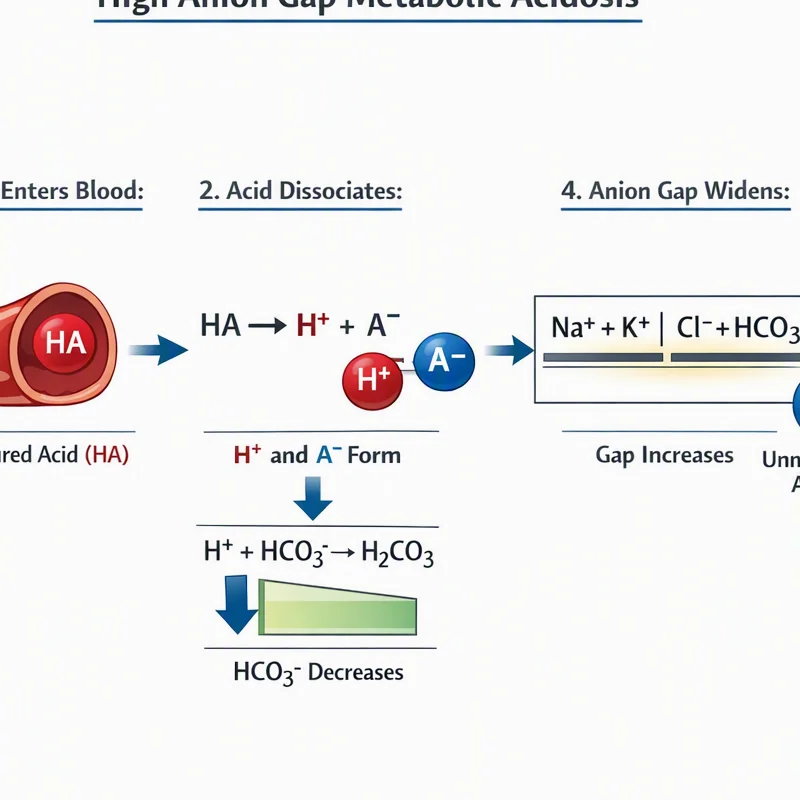
Anion gap = serum sodium - (serum chloride + serum bicarbonate)
This equation uses the primary measured electrolytes on the chemistry panel: serum sodium, serum chloride, and serum bicarbonate. The result is then checked with a lab-specific reference range. If albumin is low, the next step is to perform an albumin correction to calculate a more accurate corrected anion gap.
A frequently used approach is to add a correction for each gram per deciliter that albumin is below normal. Many clinicians use an albumin correction factor of about 2.5 mEq/L for each 1 g/dL decrease in albumin below 4.0 g/dL. The precise method may change by institution, so the calculator should be used as an estimated support tool rather than an absolute rule.
A clear example:
- Serum sodium: 140
- Serum chloride: 104
- Serum bicarbonate: 20
- Measured anion gap: 140 - (104 + 20) = 16
- Albumin: 2.0 g/dL
If albumin is 2.0 g/dL, that is 2.0 g/dL below 4.0 g/dL. Using a 2.5 correction factor, the gap is adjusted upward by about 5 mEq/L. The corrected anion gap would Have a peek here be approximately 21. This shifts the interpretation from a mildly elevated raw number to a more clearly abnormal one.
This is why a good anion gap calculator for hypoalbuminemia should not only calculate the raw result but also adjust for albumin. The calculator becomes more useful when it matches the actual chemistry of the patient, not just the uncorrected laboratory number.
How to interpret standard, raised, and decreased anion gap results
Evaluation starts with the observed value, then moves to the adjusted value if albumin is low. A normal anion gap typically suggests no major excess of unmeasured acids, though it does not exclude all acid-base issues. A normal value can still be seen in normal anion gap metabolic acidosis, where bicarbonate depletion is balanced by chloride increase, so the gap stays relatively unchanged.
A high anion gap metabolic acidosis indicates accumulation of unmeasured acids. Common causes include lactic acidosis, ketoacidosis, toxic ingestions, and renal failure. In these settings, a corrected calculation can help reveal the true extent of the disturbance when hypoalbuminemia is lowering the raw number.
A low anion gap is less common and can reflect low albumin, measurement issues, or other abnormalities. In hypoalbuminemia, a low gap may not indicate a benign state; it may simply mean the usual negative charge from albumin is missing. That is why a low measured value should prompt review of the blood gas, the chemistry panel, and the overall clinical picture.
Blood gas data helps connect the gap to acid-base status. A blood gas analysis may show low pH and low bicarbonate, confirming acidosis even when the measured anion gap looks modest. Together, the chemistry panel and blood gas provide a fuller view of acid-base balance.
As a practical rule, interpret the raw and corrected values together. If the corrected number is elevated, then a hidden acid load is more likely. If both values are normal, then the patient may have another disorder or a non-gap process. This combined interpretation enhances accuracy during patient evaluation.
Frequent causes of decreased albumin and misleading gap values
A number of conditions can cause hypoalbuminemia and make the anion gap appear reduced than it ought to. Common causes include malnutrition, liver disease, nephrotic syndrome, and inflammation. All of these are situations in which albumin production, loss, or redistribution may decrease the measured concentration.
In malnutrition, the body may not have enough substrate to maintain normal protein levels. In liver disease, albumin synthesis may be impaired. In nephrotic syndrome, albumin is lost in the urine. In inflammation, albumin often decreases as part of the acute phase response and shifts in vascular permeability. Each of these can produce a lower raw anion gap.
These conditions are important because they can result in misleading values on a serum chemistry panel. The laboratory result may look less worrisome than the actual physiologic state. A clinician who ignores albumin may underestimate the severity of a hidden metabolic problem, especially if a patient also has an acid-producing condition such as sepsis, renal dysfunction, or tissue hypoperfusion.
For that reason, any unexpectedly low or borderline gap should trigger review of albumin and the broader clinical context. In many cases, the correction is not simply a math exercise; it is a way to avoid missing a clinically meaningful abnormality.
Clinical use cases for corrected anion gap calculation
The corrected result is most useful when the purpose is to identify or more clearly define acid-base disorders in patients with low albumin. This frequently occurs in critical care, where quick physiologic changes, fluid shifts, infection, and organ dysfunction can all affect the chemistry panel.
In sepsis, for example, lactate may rise because of impaired perfusion and cellular stress. If albumin is low, the measured gap may not fully reflect the burden of lactic acidosis. A corrected value can render the hidden elevation more apparent and support timely evaluation.
In renal failure, retained acids can raise the gap. But if albumin is reduced, the raw number may be lower than expected. Correcting for albumin improves the estimate of the patient’s true acid load and can help identify mixed disorders.
The calculator is also useful in patients suspected of ketoacidosis, where the gap may be elevated but partially masked by low albumin or other concurrent conditions. In these cases, the calculator acts as a practical diagnostic aid, helping clinicians interpret an abnormal laboratory result more precisely.
In general, the corrected value is most valuable when the patient is sick, the chemistry is complex, and a simple reading of the raw number may miss important pathology. That is why many clinicians use it as part of routine patient evaluation in critical illness.
Drawbacks of anion gap calculators
Even, a carefully built anion gap calculator has significant limitations. To begin with, lab variability can alter the result. Multiple instruments, different assays, and different laboratory methods can generate mildly different electrolyte values, which directly affects the calculation.
Measurement error is an additional issue. Because the formula depends on sodium, chloride, bicarbonate, and albumin, small inaccuracies in any one component can change the final answer. A single laboratory result should therefore be interpreted with care, especially when the gap is close to the boundary of the stated reference range.
Moreover, the correction itself is an approximation. The albumin correction factor is commonly used, but it is still a reduced model. It does not fully account for every possible alteration in plasma charge balance, other proteins, or unusual toxins. That means the corrected number should guide, not replace, clinical judgment.
Another limitation is that the gap is only one element of the puzzle. A patient may have a normal corrected gap and still have a serious acid-base issue. Conversely, a slightly elevated corrected gap may not be the chief driver of symptoms. Always integrate the result with the rest of the evaluation, including blood gas analysis, vital signs, medication history, and the suspected underlying cause.
Because of this, the calculator should be viewed as an inexact guide rather than a final answer. It increases accuracy, but it does not eliminate the need for careful interpretation.
Often asked questions
What is an anion gap calculator for hypoalbuminemia?
An anion gap calculator for hypoalbuminemia is a tool that helps you calculate the raw anion gap and then adjust it for low albumin. It is used as a diagnostic aid to better interpret metabolic acidosis when albumin is reduced.
How do you correct the anion gap for low albumin?
You first use the anion gap formula with serum sodium, serum chloride, and serum bicarbonate. Then you apply an albumin correction factor, often adding about 2.5 mEq/L for each 1 g/dL that albumin is below 4.0 g/dL. The exact method can vary by institution.
Why can low albumin reduce the measured anion gap?
Reduced albumin lowers the measured gap because albumin is one of the main unmeasured anions in blood. When albumin decreases, fewer negative charges are present, so the measured anion gap can appear lower even if acid production is increased.
What is the normal corrected anion gap range?
The normal range depends on the laboratory reference range and the method used by the calculator. In general, the corrected anion gap should be evaluated against the local reference range rather than a single universal number. Always interpret the laboratory result in clinical context.
When should a corrected anion gap be used instead of the raw value?
A corrected anion gap should be used whenever albumin is low or when hypoalbuminemia may be masking a clinically important abnormality. It is especially helpful in critical illness, renal failure, sepsis, lactic acidosis, and ketoacidosis, where the raw value may miss the true acid-base disorder.