How Hyperchloremic Acidosis Relates to the Anion Gap
What Is Hyperchloremic Acidosis?
Hyperchloremic acidemia is a form of metabolic acidosis anion gap in CKD patients in which the body has more acid than base, but the anion gap stays normal. It is also called normal anion gap metabolic acidosis or non-anion gap acidosis. The main laboratory pattern is a fall in bicarbonate paired with a rise in chloride, which helps preserve electroneutrality.
This pattern is significant because it points to the mechanism of the disorder. Instead of accumulating unmeasured acids, the body often depletes bicarbonate or swaps it for chloride. That shift changes serum bicarbonate and serum chloride while leaving the calculated gap relatively unchanged. For that reason, hyperchloremic acidosis is more of a signal about the kind of acid-base problem than a single disease.
Clinically, hyperchloremic acidosis reflects an acid-base balance problem caused by an electrolyte imbalance. The blood chemistry may show low bicarbonate, high chloride, and a normal calculated gap, which is why careful clinical interpretation is essential. It is a common diagnostic clue when reviewing lab values and assessing systemic acidemia.
What Is the Anion Gap and How Do You Calculate It?
The anion gap is a calculation used to determine the difference between the primary measured cations and negative ions in blood. In routine care, an anion gap calculator helps quickly handle this step and cut down on arithmetic errors. The most common anion gap formula uses sodium, chloride, and bicarbonate values from the metabolic panel.
A basic form of the calculation is:
Anion gap = sodium - (chloride + bicarbonate)
Because sodium is the major measured cation and chloride and bicarbonate are the main measured anions, the gap reflects the amount of unmeasured ions in serum. A normal result suggests that the acid-base disturbance may be due to bicarbonate loss or chloride gain rather than an increase in unmeasured acids.
An anion gap calculator is especially helpful when reviewing serum electrolytes alongside the rest of the chemistry panel. It can support fast lab interpretation and identify whether the pattern fits a normal gap disorder or a gap metabolic acidosis. That distinction is critical to clinical interpretation because it alters the differential diagnosis.
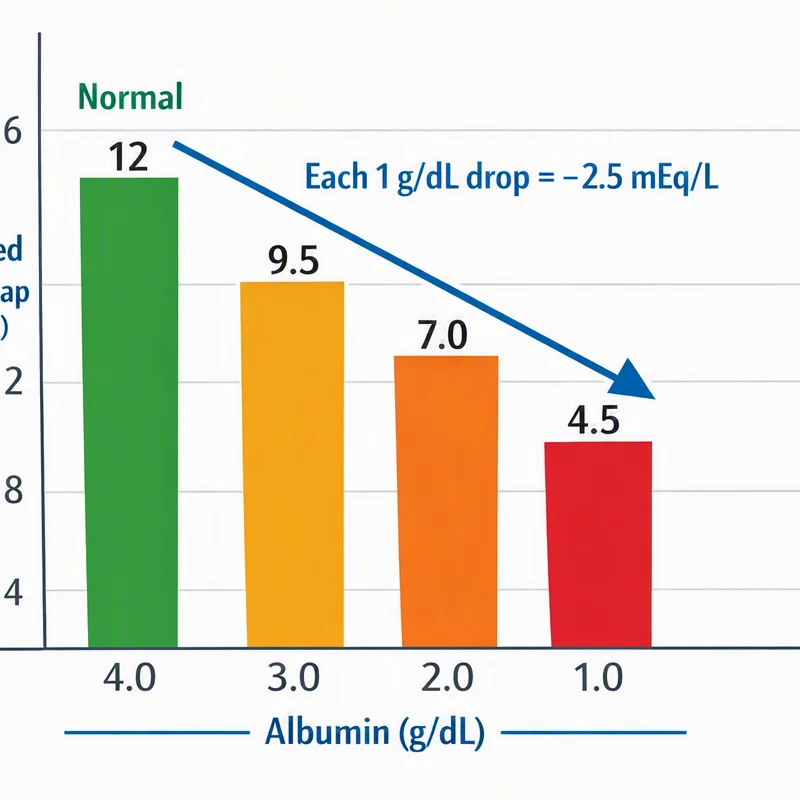
In practice, the anion gap is influenced by multiple factors, including albumin, which is a major unmeasured anion. Low albumin can make the gap appear falsely normal, so the raw number should never be interpreted in isolation.
Why Hyperchloremic Acidosis Commonly Has a Normal Anion Gap
The disorder usually produces a unchanged anion gap because the decrease in bicarbonate is matched by a gain in chloride. This interaction preserves electroneutrality. When bicarbonate is lost, chloride often increases to maintain equilibrium among the measured ions, so the calculated gap does not increase much.
This is the central difference between hyperchloremic acidosis and high gap metabolic acidosis. In high-gap states, the body retains unmeasured acids, which increases the gap. In hyperchloremic states, the issue is often bicarbonate loss or chloride replacement, so the problem shows up as a shift in measured electrolytes rather than a rise of hidden anions.
Put another way, the body may be discarding base, not gaining a large amount of new acid. That is why the lab pattern is often called normal anion gap metabolic acidosis. The chemistry pattern is still a genuine metabolic acidosis, but the chloride rise counteracts the bicarbonate decline.
This pattern is useful when examining serum chloride, serum sodium, and serum bicarbonate. If the bicarbonate is low and chloride is increased, the problem is likely a non-anion gap process. The pattern can also reflect metabolic compensation in some settings, but persistent bicarbonate loss generally indicates a primary disorder.
Common Causes of Hyperchloremic Acidosis
A number of conditions can lead to hyperchloremic acidosis, and they often share a shared mechanism: loss of bicarbonate, weakened kidney acid handling, or chloride loading. Recognizing the cause helps with specific therapy and improves acid-base balance.
- Diarrhea: Loss of bicarbonate-rich digestive fluids can result in a non-anion gap acidosis.
- Renal tubular acidosis: The kidneys cannot effectively eliminate acid or reabsorb bicarbonate, leading to renal acid excretion problems.
- Normal saline: High-volume infusion can raise chloride and lower bicarbonate, causing a hyperchloremic pattern.
- Kidney disease: Reduced renal function can weaken acid processing and contribute to electrolyte shifts.
Diarrhea is a common cause because gastrointestinal bicarbonate loss can be marked. The result is a low bicarbonate level with compensatory chloride increase. This is a straightforward example of bicarbonate loss driving a non-anion gap acidosis.
Renal tubular acidosis is a further major cause. In this set of conditions, the kidneys fail to properly acidify urine or preserve bicarbonate effectively. The disorder may be an important clue in a patient with chronic electrolyte imbalance, persistent low bicarbonate, and a normal anion gap.
Normal saline can also contribute, especially when given in high volumes. Because saline contains a high chloride concentration, it can cause a apparent increase in serum chloride and a fall in bicarbonate. This is a practical example of how treatment itself may affect blood chemistry and the acid-base picture.
Kidney disease may lead to hyperchloremic acidosis as renal function declines and acid handling becomes less efficient. In some cases, the pattern reflects decreased ammonium elimination, ongoing acid load, and impaired buffering. Reviewing the full clinical context and lab values is critical for correct diagnosis.
How to Interpret the Anion Gap in Acid-Base Disorders
Assessing the anion gap requires beyond looking at a single result. The result should be considered alongside pH, bicarbonate, chloride, albumin, and the overall acid-base disorder. A normal gap does not always mean the problem is minor, and a high gap does not necessarily mean the cause is obvious.
Albumin matters because it is a major unmeasured anion. When albumin is low, the measured gap may miss the true burden of unmeasured acids. That is why a corrected anion gap is often required. Correction helps avoid missing a hidden high-gap process in a patient whose albumin is reduced.
The delta gap is another important tool. It helps identify whether more than one acid-base process is present by comparing the rise in anion gap with the fall in bicarbonate. If the numbers do not match expected patterns, a mixed acid-base disorder may be present.
For example, a patient can have a normal anion gap acidosis and a separate high-gap process at the same time. In such cases, the apparent pattern may be misleading unless corrected for albumin and evaluated with the delta gap. This is where careful lab interpretation becomes essential.
Useful interpretation steps include:
- Check the raw anion gap and compare it with the expected range.
- Evaluate albumin and calculate the corrected anion gap if needed.
- Look at the relationship between bicarbonate and chloride.
- Use the delta gap to screen for a mixed disorder.
- Compare the pattern with the clinical picture and underlying acid-base disorder.
This approach allows more accurate clinical interpretation and helps distinguish a pure hyperchloremic process from a more complex acid-base disturbance.
When a High Anion Gap and Chloride elevation Can Occur together
A elevated anion gap and hyperchloremia can occur together when multiple process is happening at once. This is a classic mixed acid-base disorder. The patient may have a elevated-gap process from one cause and a hyperchloremic component from another.
Common examples include lactic acidosis, ketoacidosis, and toxic ingestion. These conditions often increase unmeasured acids, leading to a raised anion gap. At the same time, chloride may go up or bicarbonate may decrease further, producing a second pattern that can blur the overall picture.
For instance, a patient with ketoacidosis may receive large volumes of normal saline, which can add a hyperchloremic component to the already existing high-gap disorder. Similarly, lactic acidosis may occur alongside with chloride retention or bicarbonate loss, making the lab values more difficult to interpret.
Toxic ingestion can also produce mixed patterns depending on the substance and the timing of presentation. Some toxins cause high-gap acidosis directly, while treatment or fluid shifts may later add a hyperchloremic component. This is why looking only at the anion gap without the rest of the blood chemistry can miss important context.
The delta gap is especially useful here because it helps reveal whether the bicarbonate drop is more pronounced or less severe than expected from the rise in anion gap alone. When the numbers do not fit a single disorder, mixed physiology should be strongly thought about.
How a Anion Gap Calculator Supports Clinically
A anion gap calculator is an effective tool for quick review of serum electrolytes. It supports bedside clinical decisions by helping clinicians compare sodium, chloride, and bicarbonate values efficiently. This makes it easier to identify whether a patient has hyperchloremic acidosis, a high-gap disorder, or a mixed presentation.
In daily practice, the calculator helps with:
- Rapid screening of electrolytes during evaluation of acidemia.
- Improved lab interpretation when bicarbonate is low.
- Following serum bicarbonate changes over time.
- Aiding review of serum chemistry panels in complex cases.
- Noticing when chloride rise suggests a non-anion gap process.
The tool is most valuable when paired with clinical context. If the patient has diarrhea, renal tubular acidosis, recent saline resuscitation, or kidney disease, the anion gap result may help support the likely mechanism. If the gap is unexpectedly high or normal in the setting of serious illness, that may be a signal to look for a hidden mixed disorder.
A calculator does not take the place of judgment, but it strengthens it. By combining the anion gap with albumin correction, bicarbonate review, and delta gap analysis, clinicians can interpret blood chemistry more confidently and identify the source of the acid-base imbalance.
Used well, the anion gap calculator becomes more than a math tool. It becomes a diagnostic aid that supports better recognition of electrolyte patterns, quicker clinical interpretation, and more targeted management of systemic acidemia.
Common Questions
In what way is hyperchloremic acidosis distinct from high anion gap acidosis?
Hyperchloremic acidosis often presents as a normal anion gap metabolic acidosis due to bicarbonate loss or chloride gain, whereas high anion gap acidosis involves the buildup of unmeasured acids. In hyperchloremic acidosis, chloride rises as bicarbonate falls, but in high anion gap states the gap increases because of acids such as lactate or ketones.
What causes hyperchloremic acidosis often have a normal anion gap?
It typically has a normal anion gap because the decrease in bicarbonate is offset by an increase in chloride, preserving electroneutrality. Because the measured ions move in opposite directions, the calculated anion gap usually remains in the normal range.
Is it possible for normal saline cause hyperchloremic acidosis?
Yes, it can. High volumes of normal saline may increase chloride and dilute bicarbonate, resulting in hyperchloremic acidosis. This is a frequent cause of non-anion gap acidosis in patients who get significant fluid resuscitation.
How do you compute and adjust the anion gap with respect to albumin?
You compute the anion gap by subtracting the sum of chloride and bicarbonate from sodium. To adjust for albumin, you raise the result when albumin is low because low albumin can make the gap seem falsely normal. This albumin-corrected anion gap offers a better estimate of hidden unmeasured acids.
What conditions commonly cause hyperchloremic acidosis?
Common causes include diarrhea, renal tubular acidosis, administration of normal saline, and kidney disease. These conditions often lead to bicarbonate loss, impaired renal acid excretion, or chloride loading, all of which can produce a normal anion gap pattern.